
Delirium
- Download our interim review report that showcases the progress made by the delirium programme over the last two years: Greater Manchester delirium programme – two year review. June 2024
- Greater Manchester’s successful delirium Singapore observer-ship. Evaluation report & communications round up. Find out more
Across Dementia United we’ve been working in collaboration with lived experience advisors since 2018. For the delirium programme we created this webpage to capture lived experience accounts and to share the resources created. Health and care staff from across Greater Manchester have told us that these accounts are very powerful and that they welcome us sharing these alongside our delirium training resources as they assist them in raising awareness about the importance of improving the detection and management of delirium. Find out more here
Delirium is a condition which causes a short-term confused state and develops over hours and days. It causes short term problems with memory, concentration, attention and personality. It occurs when a person is medically unwell and can be caused by several things, such as infections, pain or constipation. People living with dementia are more likely to experience delirium. People may go on to develop delirium, whether they are in hospital, in a care home or living at home.
Why does identifying delirium early and treating it matter?
Where delirium is not detected and treated, people’s outcomes are much poorer. Delirium can lead to increased hospitalisation and readmission, increased likelihood of placement in a care home and can make the symptoms of dementia worse. Prevention, early detection, standardised assessment and treatment all improve these outcomes.
What are we doing to address the issue?
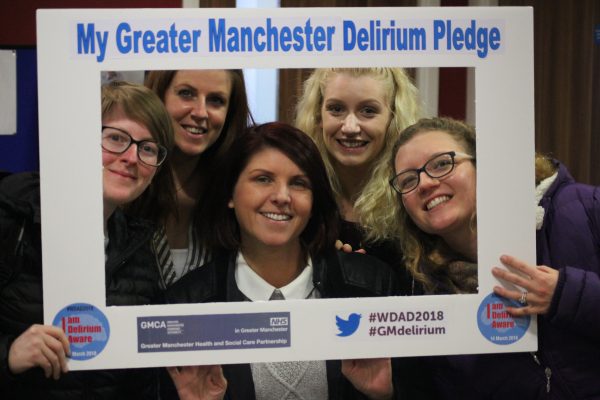
Dementia United produced a Greater Manchester approach to delirium which outlines Greater Manchester’s position on the recommendations for a person-centred pathway for those susceptible to delirium along with key standards. These key standards have served as the basis for a number of resources produced by Dementia United:
- Greater Manchester community delirium toolkit Updated January 2024 Our community toolkit is intended to be used by health and social care staff to help them identify their patients who are experiencing delirium and manage them appropriately.
- Greater Manchester hospital delirium toolkit Updated January 2024 Our hospital toolkit is intended to be used by health staff in a hospital setting to help them identify their patients who are experiencing delirium and manage them appropriately.
- Delirium toolkit training resources. This includes resources useful for anyone (people living with dementia, family members, carers, and health and social care staff). There are also resources catered specifically towards hospital staff and staff working in the community.
- Greater Manchester delirium leaflets. Our leaflets are designed to be printed and used with people who are either at high risk of developing delirium, have a current delirium, or are a loved one of someone who has experienced delirium. There is a long version Greater Manchester Delirium Leaflet Long Version June 2023 a short version Greater Manchester Delirium Leaflet Short Version June 2023 and translated versions available in sixteen languages: audio, print and video.
- Delirium – top tips for carers or family members This guide provides advice for prevention, identifying the signs of delirium and getting help.
Dementia United’s delirium data
The Greater Manchester delirium emergency admissions dashboard has been developed to provide a comprehensive, real-time view of delirium care across the region. It integrates secondary care data and includes emergency hospital data where delirium is identified. You can find out more here